
Discover your ancestors on southcarolinapioneers.net
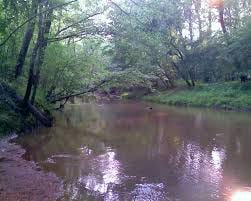
Pictured is Duncan’s Creek in South Carolina courtesy of City-Data.com.
Upper South Carolina was first an Indian Territory. However, its beauty was left uncultivated and undirected by the Indians. He built no palaces, reared no cities, set in motion no time-saving machinery, and whitened no sea with the floating canvas of widespread commerce. He never wanted to take the life of the least valuable animals in his forest. His landed inheritance was given to him from the hands of God. It was a magnificent country, and a magnificent country still; he yielded it up to the more vigorous race that supplanted him. Mapping out, for our purpose, that portion of the State, which may be styled the upper country, we shall be guided not so much by its geographical limits as by its revolutionary and primitive relations. The territory embraced in the modern Districts of Abbeville, Anderson, Edgefield, Greenville, Pickens, Newberry, Laurens, Union, Spartanburg, Fairfield, Chester, Lancaster, York, and Ricliland is the classic ground of the American Revolution.
When the English came, they found this beautiful peninsular dividing and common hunting ground between the Cherokees and Catawbas. As late as 1775, the woodlands, carpeted with grassy and the wild pea-vine growing as high as a horse’s back and wildflowers of every hue, were the traveler’s and adventurous pioneer’s constant admiration.
When the first settlers of Duncan’s Creek arrived from Pennsylvania and began to erect their cabins on that fertile stream, they found its valleys and hills abounding in buffaloes. Their deep-worn trails, leading to favorite ranges and licks, marked the country in every direction, and long after the struggling settlement had become a flourishing community, and not a buffalo remained in those parts, these paths could still be traced along the creek and its tributaries.
Bartram, in the narrative of his passage from this same ancient trading post, in 1773, by old Fort Charlotte to the Cherokee towns at the head of the Savannah, described a spot, not far from the latter place, where he found large quantities of moss-covered bones, of both men and buffaloes, lying scattered indiscriminately over the ground. The Cherokee Indians called the buffalo Canada the very great bull, or the Bull of God, and this was the universal name among all the tribes of North America for this animal—a presumptive proof of their common origin. The women made cloth from the thick, shaggy hair of this animal. Young warriors often wore locks or rolls of this fur, drawn through their long slitted ears and, on great festive or military occasions, mounted upon their brows, already sufficiently hideous from paint a pair of buffalo horns, with the appendage of the tail, also, in its proper place.
In 1760, Mr. Graves, an old man, crossed the Wateree at Grave’s Ford and formed a settlement in the present territory of Fairfield. When his people had kindled their fires, soon after passing the river, he looked into the larder and announced to the company that their meal and meat were both entirely exhausted; “but,” said he, ” as we crossed the river, I saw tracks in the paths, leading up from it into the woods, which must be those of the buffalo. Let the young men take their guns and waylay the trails, and they will, no doubt, soon take us a fresh supply of meat.”
Reuben Harrison, who was one of the party, immediately formed a hunting band, and going out, as directed, was not long in killing three fat buffaloes, which they succeeded in bringing into the encampment. After cutting from their carcasses what they needed for their necessities, the rest was divided into small pieces and spread upon a log to cool during the night. The wolves of the neighboring swamps, having gotten the scent of it, surrounded the camp with the most hideous howling; when daylight came, scarcely half of the game could be found.
The venerable Busby, who lived to the advanced age of one hundred and ten years, told that he had often seen, at one time, three thousand buffaloes on the Long Meadows of Little River in the same territory.
Source: HISTORY UPPER COUNTRY SOUTH CAROLINA, EARLIEST PERIODS CLOSE OF THE WAR OF INDEPENDENCE. JOHN H. LOGAN, A. M. VOL. I. PUBLISHED BY S. G. COURTENAY & CO., CHARLESTON, P. B. GL.ASS; COLUMBIA. 1859.